weaving
Six signs of quality in handwoven work
Tension, turns, terminations and tails. What experienced buyers actually look at when they pick up a woven piece, and why price alone tells you very little.
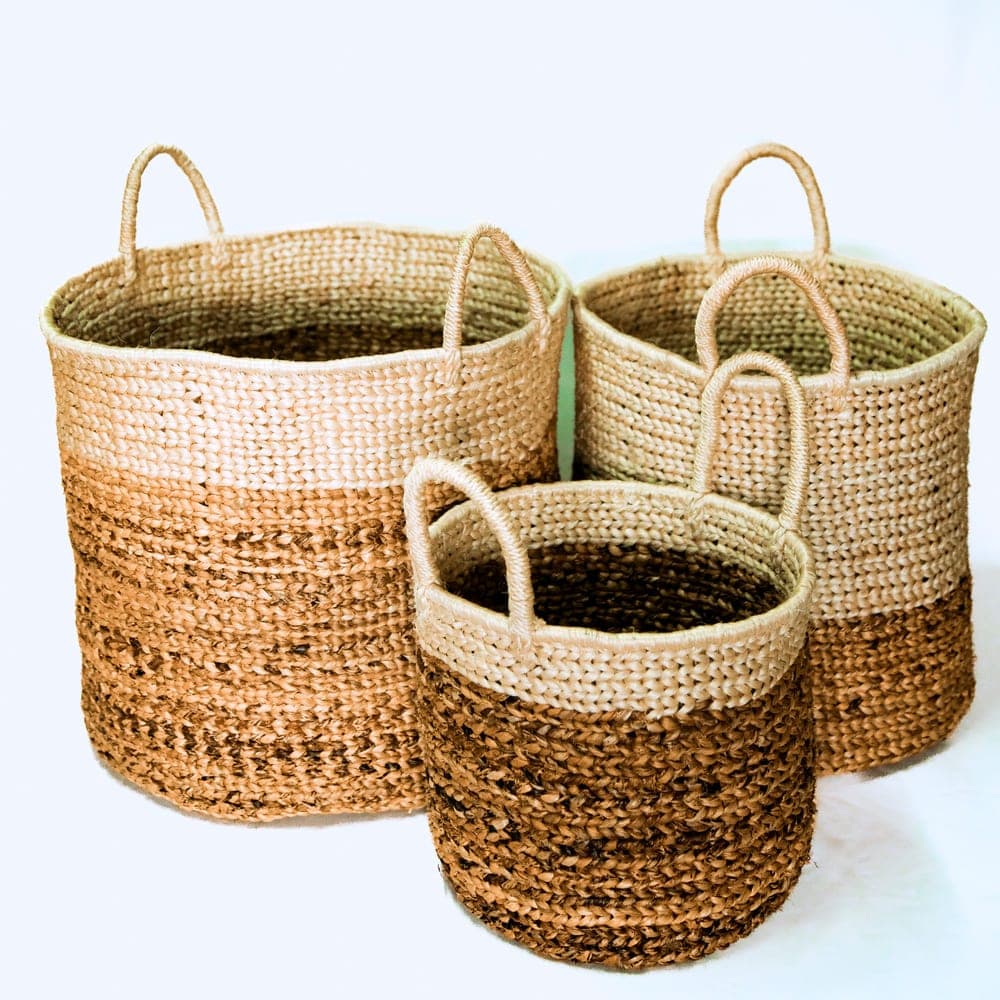
Two baskets of the same size, the same fibre and the same pattern can represent a three-fold difference in hours. Almost none of that difference shows in a photograph, and quite a lot of it shows in thirty seconds of handling. Here is what to handle for.
1. Stitch density
The single most useful measure. Count the stitches across two centimetres of the coil, anywhere on the side wall. Fine work runs roughly twice the count of quick work, and since every stitch is a separate motion, that is a direct multiple of labour. It is also the hardest thing to fake.
2. Tension consistency
Press gently into the side wall with a thumb. It should feel uniformly firm. Soft patches mean the weaver’s tension drifted — usually late in a long session — and those areas will be the first to deform in use.
3. What happens at the turns
A diagonal or chevron pattern has to travel around a changing circumference. Skilled weavers plan the increases so the pattern stays true all the way up; less careful ones let it drift and then correct it abruptly. Follow one diagonal line with your eye from base to rim. If it wanders and then jumps, you have found the compromise.
4. The rim
The final round is where fatigue shows. It should be the same density as the rest of the piece and finished with a deliberate binding rather than simply stopping. A rim noticeably looser than the body means the maker was finishing rather than weaving.
5. Terminations and tails
Every new length of fibre has to be started and ended. On careful work those joins are buried and effectively invisible; on quick work you will find cut ends poking out, mostly on the inside where nobody photographs. Turn the piece over and look inside with real light.
6. Whether it sits
Put it on a flat surface and press one edge. A basket that rocks was taken off the working surface out of round, and no amount of pattern quality compensates for a piece that will not sit still on a shelf.
Price tells you what someone is asking. Stitch density tells you what they spent.
What none of this measures
Design. A technically flawless basket in a dull pattern is still a dull basket, and a slightly uneven one with a pattern that genuinely sings is worth owning. The checks above are for deciding whether you are paying a fair price for the hours — not for deciding whether you want it.
The same six, applied to flat textiles
Woven cloth and wall hangings answer to the same questions in different words:
Density becomes thread count. Hold it to the light. Even, closely spaced picks mean a weaver who kept a steady beat.
Tension becomes selvedge. The finished side edges should be straight and the same width top to bottom. A waisted textile was woven at drifting tension and will never hang flat.
Turns become pattern registration. Where a motif repeats, check that it repeats at the same width each time.
Rim becomes the finish. A deliberate hem, twist or fringe, not a raw cut edge.
Terminations become the reverse. Turn it over. Floats and loose ends on the back are where corners get cut.
Three things that look like faults and are not
Slight colour variation between areas. That is a dye bath exhausting, and on hand-dyed fibre it is expected. Perfect uniformity is the thing that should raise a question.
A deliberate irregularity in a pattern. Present in many traditions on purpose. Ask before you call it an error.
Fibre smell. New sisal and papyrus smell of plant matter for weeks. It fades.
Three things that look minor and are not
A soft patch in the wall. That is where it will deform first, and it will.
A rim noticeably looser than the body. The structure ends at the rim; a weak one unravels the whole piece over years.
Mould smell. It means the piece was stored damp. The visible growth can be dealt with; the weakened fibre cannot.
A fair test for a fair price
Estimate the hours from the density, multiply by a wage you would consider decent, add materials, and see whether the asking price is in the same neighbourhood. If it is far below, ask where the difference came from. The answer is sometimes a legitimate efficiency and sometimes a person who was not paid.
More from the journal
shipping
Shipping art internationally, without disasters
Packing, paperwork, duties and the questions to ask before you buy from another continent. Most shipping problems are declaration problems.
4 min read
pricing
What handmade actually costs
Where the money goes when you buy a handmade object, why the cheap version is cheap, and what a fair price looks like from the maker’s side.
4 min read

gifting
Giving art as a gift, well
Art is a wonderful gift and a risky one, because taste is not transferable. How to give something that gets hung rather than stored.
3 min read