interiors
Choosing art for a small room
The instinct in a small space is to hang small things. It is almost always wrong. What actually works when the wall is close to your face.
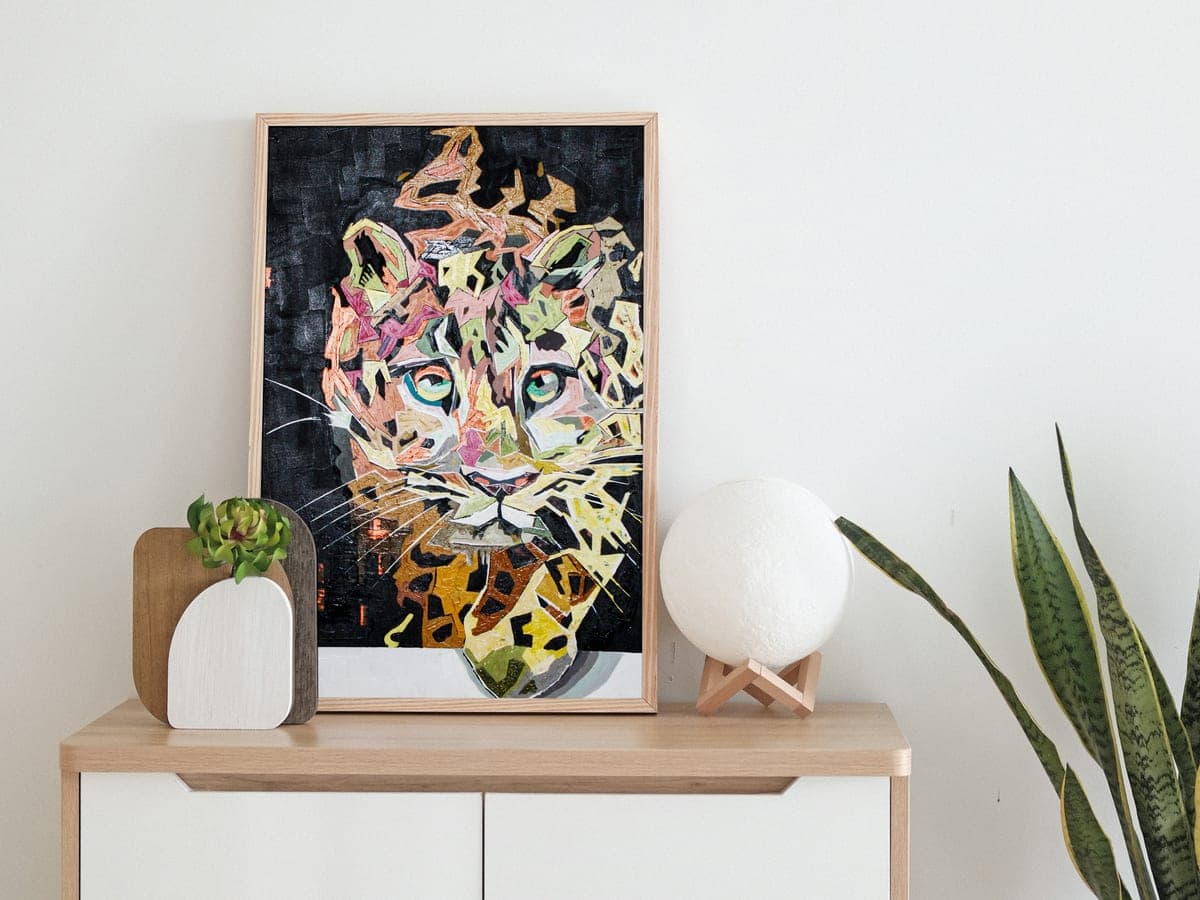
Small rooms get small pictures, and small pictures make small rooms feel smaller. The logic seems sound and it is backwards: a scatter of little frames fragments a wall into pieces, and a fragmented wall reads as clutter, which reads as less space.
One large piece, most of the time
A single work covering a good proportion of the wall does two useful things at once. It gives the eye one place to rest instead of six, and — because you cannot take it in at a glance from close range — it implies a viewing distance the room does not actually have. That implication is what makes the wall feel further away.
Viewing distance changes what works
In a corridor or a small bathroom you are standing 60 to 100 cm from the wall. At that range, detail is everything and composition is almost irrelevant — you cannot see the whole thing at once anyway. This is the ideal place for work that rewards close looking: fine weaving, a detailed drawing, beadwork, a banana-fibre mosaic. Save the bold graphic composition for the room where you can stand back from it.
The corridor rule
Hang along a corridor at a consistent height, evenly spaced, all the same size if possible. A corridor is experienced in motion, and rhythm reads better than variety when you are walking past.
Texture beats colour in tight spaces
A strong colour in a small room is on top of you all day. Texture is not — it changes constantly with the light and it never shouts. Woven panels, ceramic wall pieces, raised-surface work like imigongo and anything with real depth in it will hold interest in a confined space far longer than a flat bright image will.
In a room you cannot step back in, choose work that gets more interesting as you get closer.
Practical constraints worth respecting
Humidity. Bathrooms and small kitchens are hostile to paper, textile and natural fibre. Ceramic, metal and sealed wood are not bothered.
Doors and traffic. Anything that projects from the wall in a narrow space will eventually be caught by a shoulder or a bag.
Reflections. Glazing opposite a window in a small room shows you the window, not the art. Use anti-reflective glazing or hang on the same wall as the window.
What to skip
The gallery wall. It is a beautiful device in a big room and a mess in a small one — too many edges, too many frames, and nowhere for the eye to go. If you own many small pieces and one small room, rotate three of them rather than hanging fifteen.
Room by room
Hallways and corridors. Close viewing, in motion. Detailed work, hung in a consistent rhythm.
Small bedrooms. The first and last thing you see each day. Quieter work, and nothing above the bed that is heavy or glazed.
Bathrooms. Humidity swings destroy paper and textile. Ceramic, metal, sealed wood, or nothing.
Small kitchens. Grease travels further than people expect. Glazed, and cleanable.
Home offices. Behind you, not in front. Work in your eyeline all day stops being seen within a week.
The mirror question
A mirror opposite a window genuinely makes a small room brighter, and it will also reflect whatever is on the opposite wall — including the back of a piece of art, or a glare-covered frame. Decide which wall the mirror is answering before you commit either.
One wall, three sizes
One piece at roughly two thirds of the wall width. The strongest and simplest option, and the one most people talk themselves out of.
A vertical pair. Draws the eye up and works well on a narrow wall between a door and a corner.
A tight cluster of three, small gaps. Reads as one object rather than three, which is the whole trick.
Negative space is not wasted space
The single most common mistake in a small room is filling every wall. A room with two considered pieces and three empty walls feels larger and more deliberate than one with eight. If a wall feels bare, live with it for a month before buying anything — most of the time the feeling passes and what you would have bought would have been furniture-shaped rather than something you wanted.
In a small room, what you leave off the walls is doing as much work as what you put on them.
More from the journal
shipping
Shipping art internationally, without disasters
Packing, paperwork, duties and the questions to ask before you buy from another continent. Most shipping problems are declaration problems.
4 min read
pricing
What handmade actually costs
Where the money goes when you buy a handmade object, why the cheap version is cheap, and what a fair price looks like from the maker’s side.
4 min read

gifting
Giving art as a gift, well
Art is a wonderful gift and a risky one, because taste is not transferable. How to give something that gets hung rather than stored.
3 min read