care guide
Caring for textiles and wall hangings
A hanging textile is fighting gravity every day of its life. How to hang it so it does not lose, plus cleaning, moths and long-term storage.
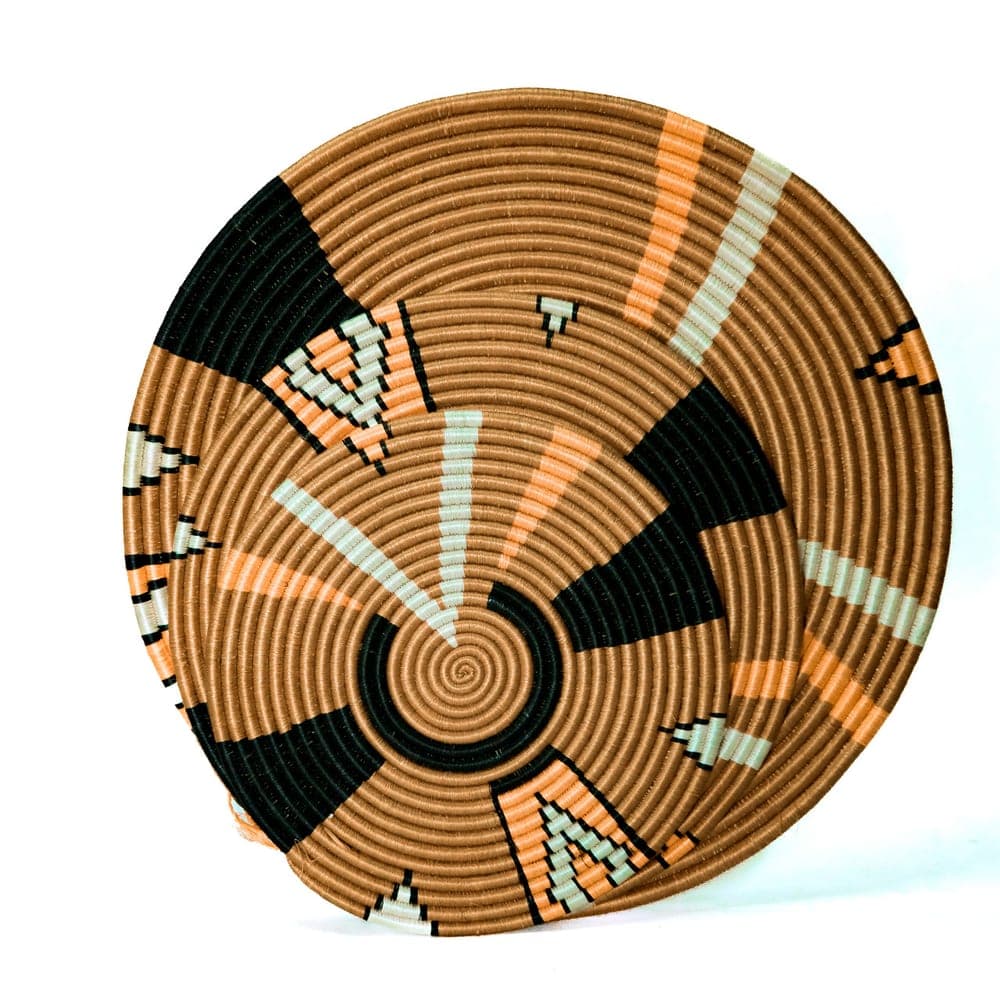
Everything else you own on a wall is rigid. A textile is not, and every day it hangs it is being pulled downward by its own weight. Whether it survives that gracefully or slowly deforms into a lopsided version of itself is decided entirely by how it is hung.
Spread the load, always
Never hang a textile from two nails, two clips or two corners. The load concentrates at those points and the fibres there take all of it. Within a few years you get visible distortion at the top corners and eventually tearing.
The correct method is a full-width sleeve: a strip of washed cotton or linen stitched to the back along the top edge, forming a channel for a wooden batten or a metal rod. Every centimetre of the top edge then carries its own share. Stitch it by hand with thread weaker than the textile itself, so that if anything ever fails it is the stitching and not the piece.
Turn it around
Take the hanging down twice a year, turn it end for end if the design allows, and give it a day flat on a bed. This redistributes the stress and lets the fibres relax. It is the single most effective thing you can do and it takes ten minutes.
Cleaning
Vacuum, gently. Low suction, through a screen or muslin held between nozzle and textile, never touching the surface. Two or three times a year.
Test before any water touches it. Dampen a white cotton bud, press it to an inconspicuous area, and look for colour transfer. Natural dyes very often run.
Do not machine wash, ever. Agitation felts, shrinks and distorts hand-woven fabric permanently.
Take real stains to a textile conservator. Not a dry cleaner — the solvents are wrong and the handling is worse.
Insects
Moths and carpet beetles eat protein fibre — wool and silk — and ignore cotton, sisal and papyrus. The larvae do the damage and they prefer dark, undisturbed places, which is exactly what the back of a wall hanging is. Inspect the reverse twice a year, looking for fine grit-like frass and irregular grazed patches. Freezing is the reliable domestic treatment: seal the piece in a bag, freeze for two weeks, thaw slowly, then vacuum thoroughly.
Cedar and lavender deter adult moths and do nothing whatsoever to larvae already in the fibre. Inspection is the only thing that works.
Storage
Roll, do not fold. Folds become permanent creases and creases become splits. Roll around a wide tube with acid-free tissue between the layers, design side out.
Cotton, never plastic. Plastic traps moisture against the fibre and is how mould starts.
Store horizontally, raised off the floor, somewhere with stable temperature.
Building the sleeve
Cut a strip of washed, unbleached cotton or linen, the full width of the piece less about two centimetres at each end, and wide enough to fold into a channel with clearance.
Turn and press the long edges, then press a fold along the length so the channel stands slightly proud of the backing.
Stitch it by hand along both long edges, catching only the backing threads, never going through to the face.
Use thread weaker than the textile. If anything ever gives, it must be the stitching and not the piece.
Slide in a sealed wooden batten or a metal rod, and hang the rod, not the fabric.
Sealing the batten
Raw wood in permanent contact with a textile is an acid source and a moisture reservoir. Seal any wooden batten with an inert varnish or wrap it in polyester film or washed cotton before it goes into the sleeve. Aluminium tube avoids the question entirely and is lighter.
Reading the damage you already have
A wavy bottom edge. Uneven tension along the top. Rehang from a proper sleeve and give it a few weeks flat.
Corners pulling into points. Classic two-nail damage. Stop hanging it that way immediately; the distortion may be permanent.
Faded on one side only. A light problem. Rotate it and move the piece.
Small irregular holes with fine grit nearby. Insects, active. Freeze it.
The freezing method, exactly
Seal the piece in a plastic bag with as much air pressed out as possible, and freeze at −18°C or below for two weeks. Take it out and let it come to room temperature still sealed, over several hours, so condensation forms on the bag and not on the textile. Then vacuum thoroughly through a screen. Repeat once after a fortnight to catch anything that hatched.
Twice a year: take it down, turn it round, lay it flat for a day, and look at the back. That single habit outlasts every product you could buy.
More from the journal

framing
Framing works on paper without ruining them
Framing is the most common way people quietly destroy the art they own. Four decisions decide whether a drawing survives the next thirty years.
4 min read

hanging
Hanging art: a practical guide
The one measurement that fixes most rooms, how to group work without it looking like a grid, and the fixings that actually hold.
4 min read
care guide
Caring for handwoven baskets
Natural fibre is a material that keeps moving. How to clean a basket without wrecking it, why sunlight is the real enemy, and what to do when one goes out of shape.
4 min read